Takes in
The Rokoko takes imported, cut by frame range and cleaned by scripts inside the editor, rerun from the raw take after every change.
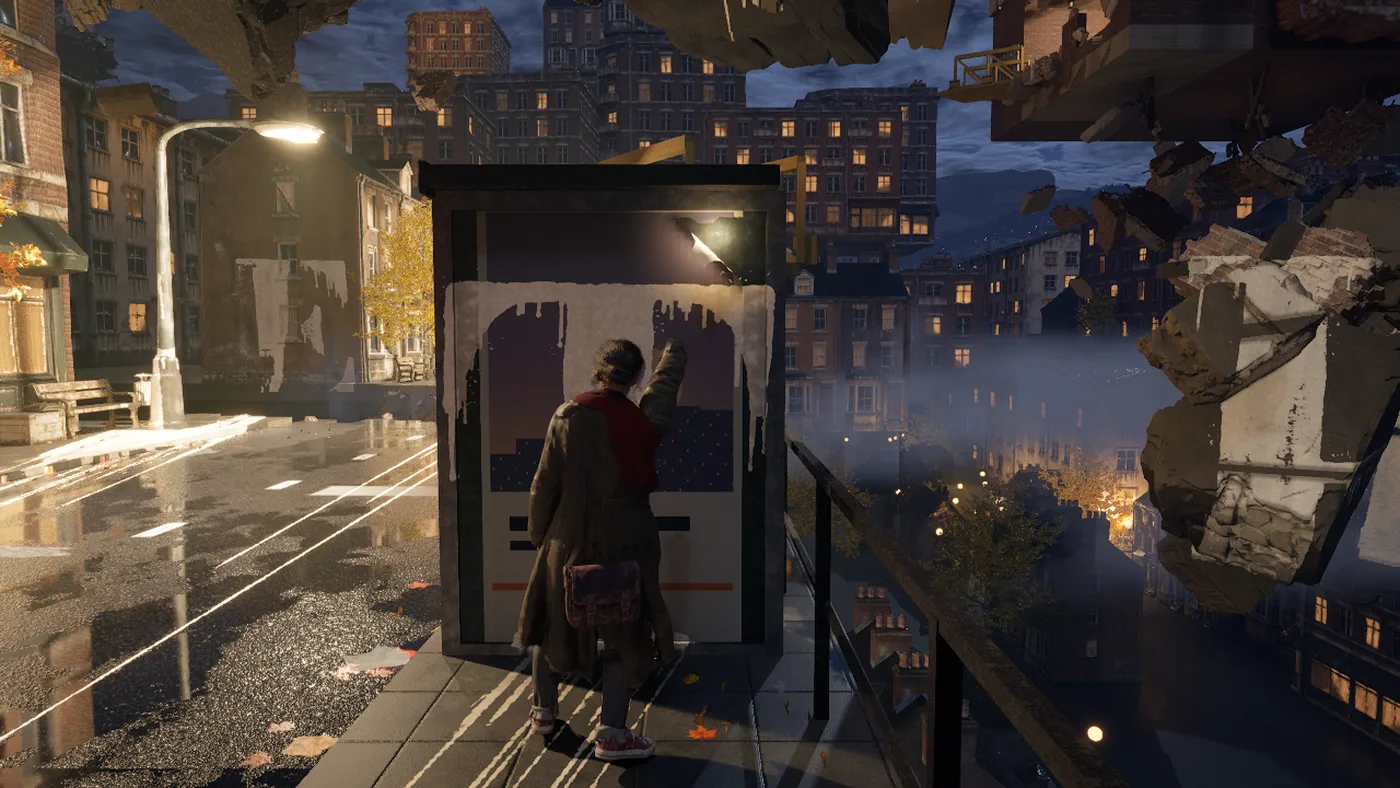
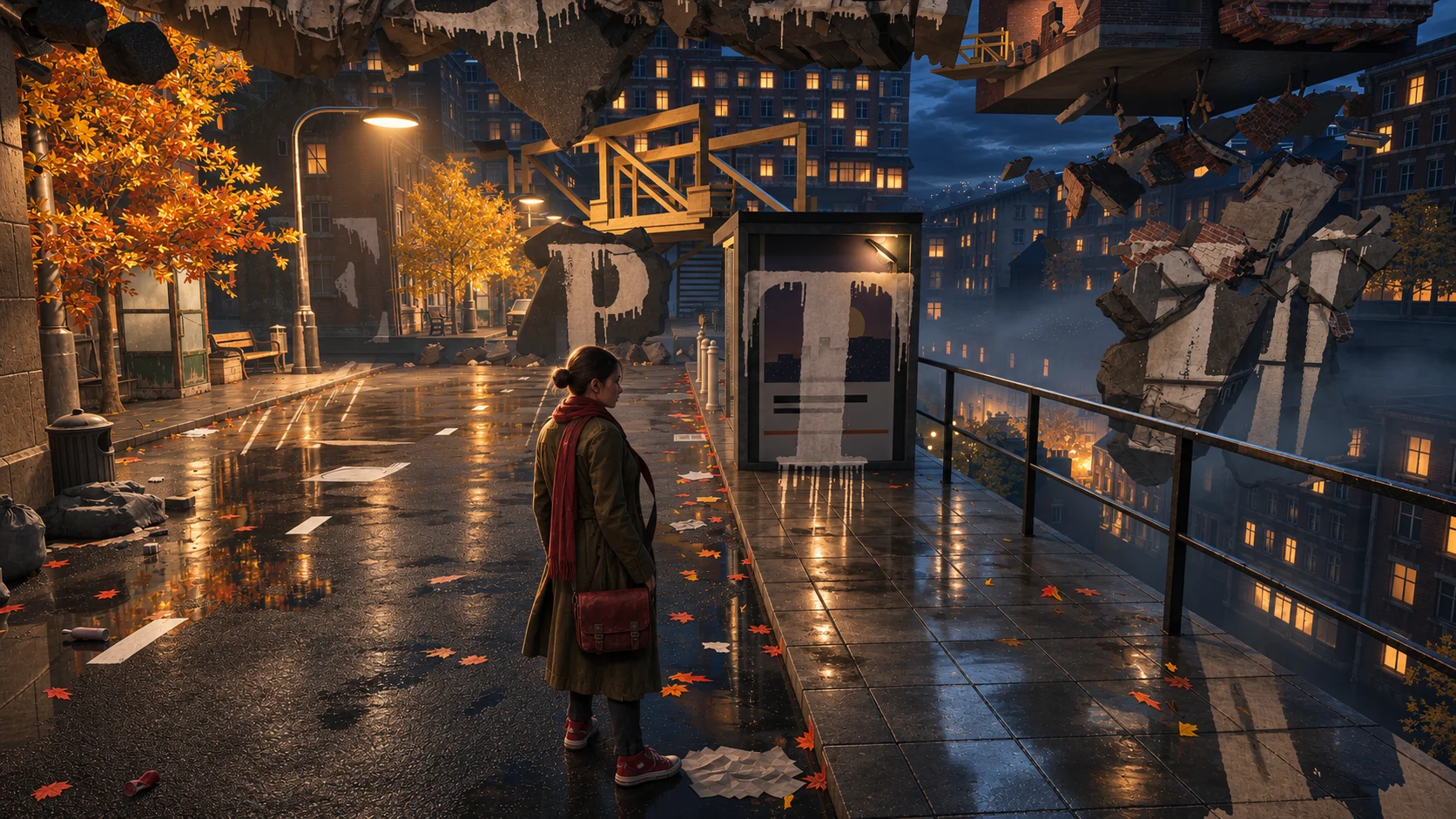 In-game screenshot, light and detail polished with an AI image pass
This devlog is late. The jam ran out faster than the blog posts did, and every spare hour went into the game instead. This post covers the character: her new design, how she was rebuilt, and how Laurent's own movements ended up in her body.
A quick note on the name: the game was still called Wake Up when devlog 1 went out. Devlog 5 tells where that name came from. It's False Depth now.
Nat's latest concept frames moved the whole city on, and she had to follow. Her first outfit, a tan hooded jacket, belonged to a cleaner, brighter game. She got a long waxed coat, a crimson scarf thrown over one shoulder, worn red sneakers and a satchel, all dirtier. From behind, which is how you see her most of the game, the scarf is the first thing you read.
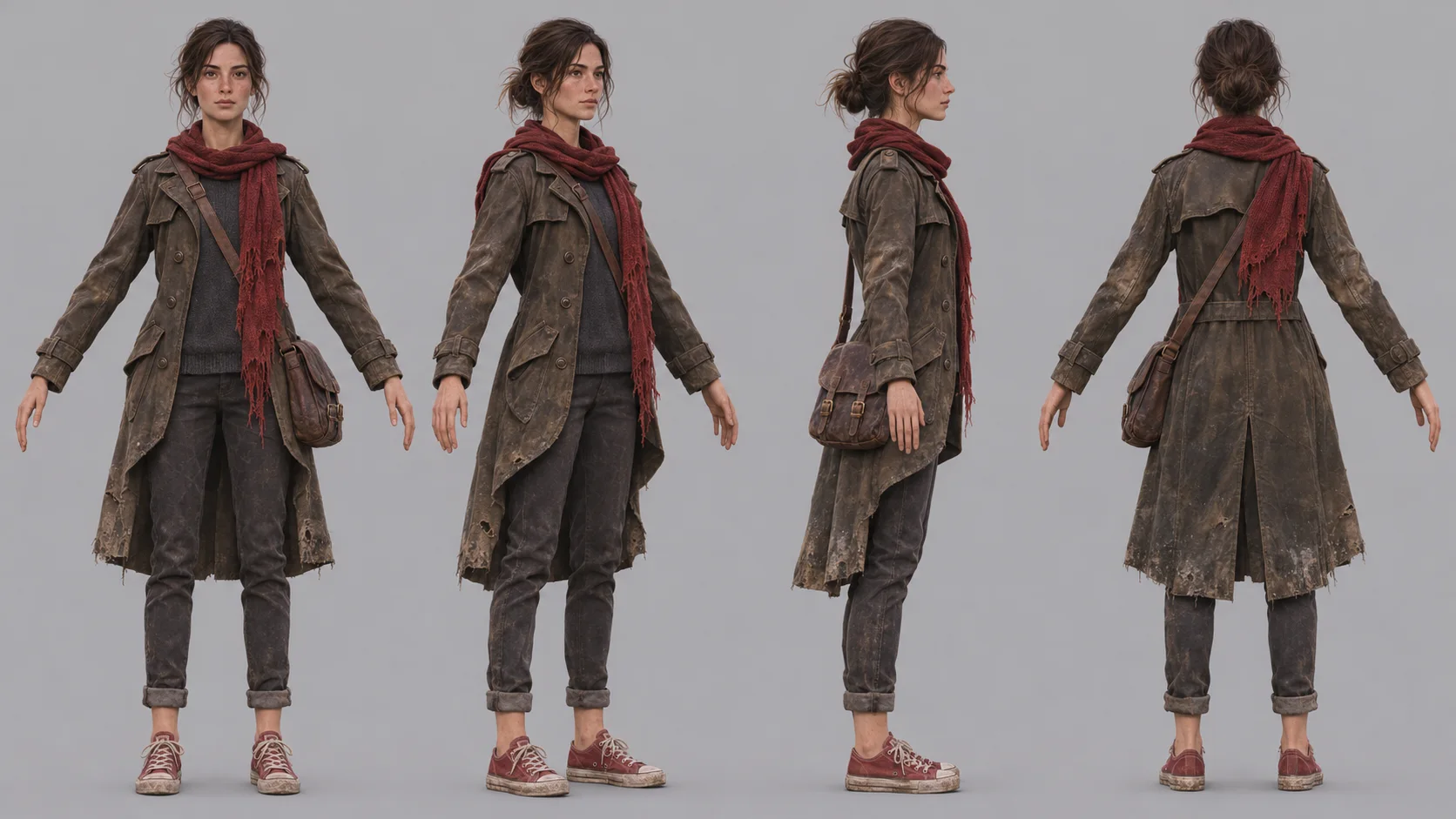
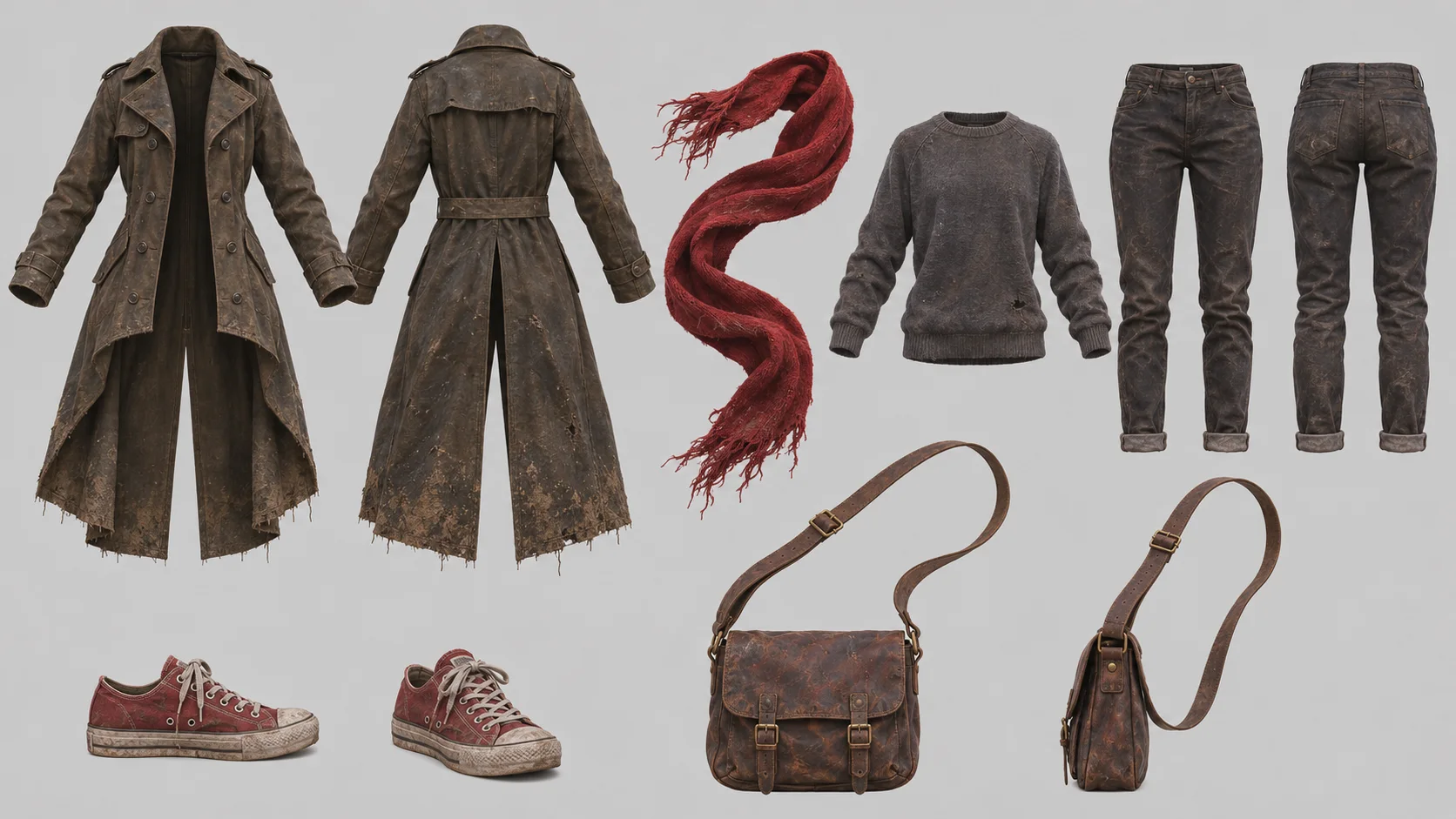
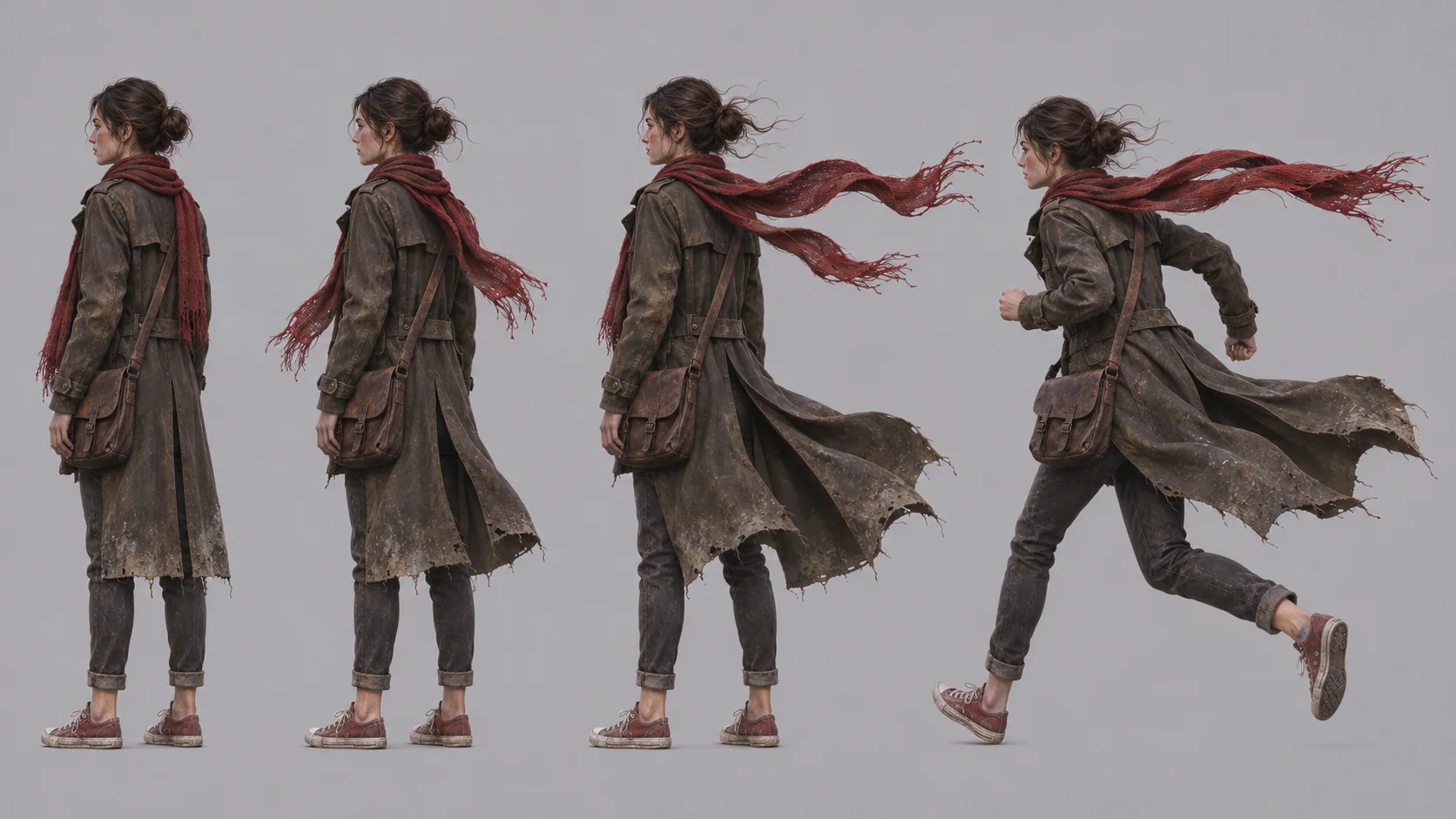
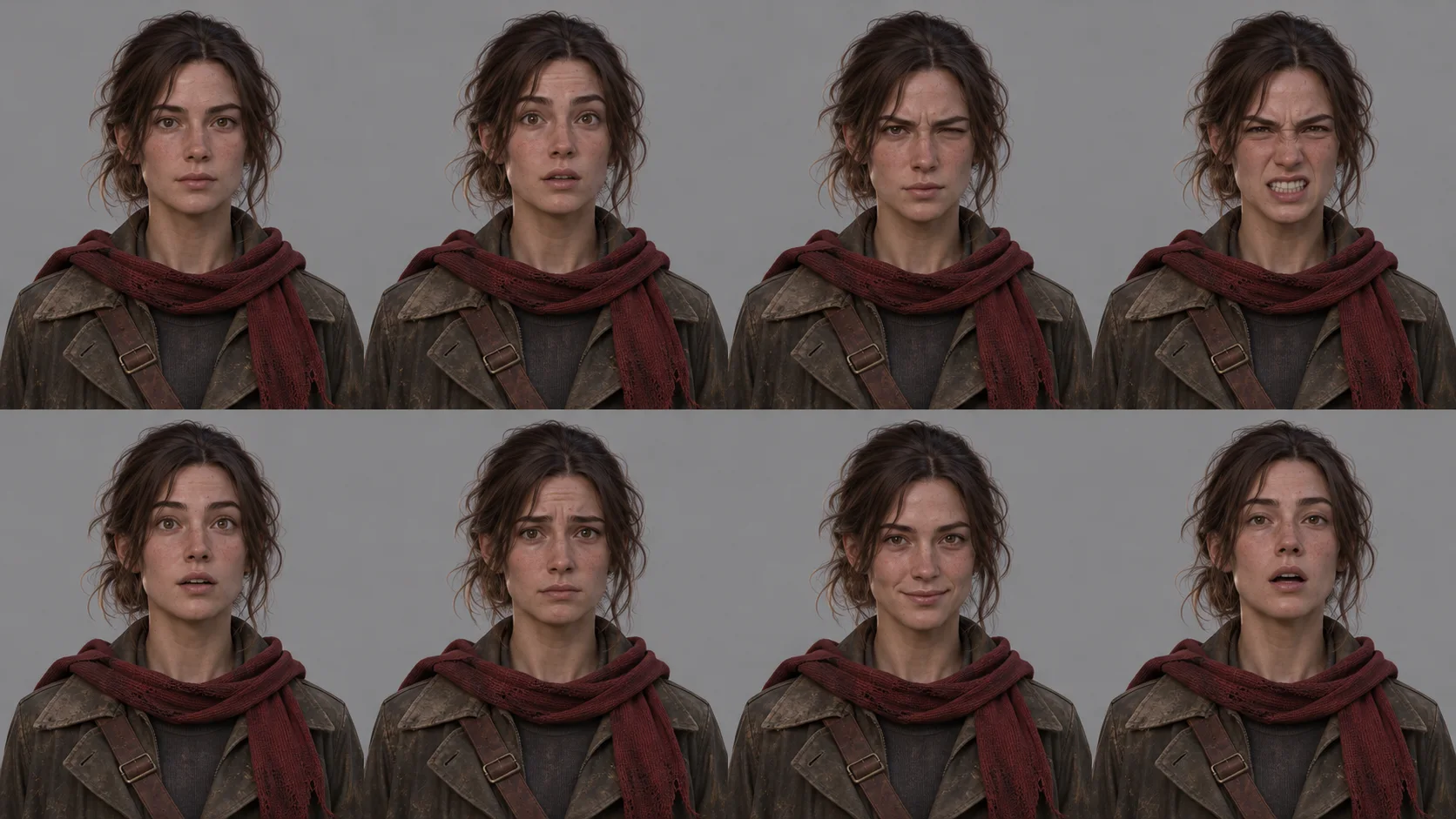
Her new reference sheets. Generated concept art.
You spend the whole game behind her, watching her walk, stop, reach and pull. If that movement feels canned, the city around her stops feeling strange and starts feeling fake. So Laurent put on a Rokoko suit and recorded ten takes: four of just standing around, two walks, and one for each thing the puzzles ask of her. Holding a photo up to eye height, hauling a rope hand over hand, reaching for a poster's corner and tearing it down, squatting to pick something up.
A raw take isn't a game animation. Each one starts on a frame of bind pose, none of them loops, and the travel sits on the hips instead of the root, so the character drifts away from her own collision. Planted feet slid 6 to 12 cm per second, which reads as skating, and a standing spine has a small tremor that reads as nerves on a character.
Rokoko suit, ten takes, filmed on a phone
Each move cut out by frame range: the haul, six tears, three pickups
Feet locked to the floor, spine smoothed, travel moved to the root, facing fixed
Arms eased out so they clear her coat, knees apart, loops closed
Into motion matching, or onto a puzzle move in the level
A script does all of it, so every fix can be rerun from the raw take. After cleanup her planted feet slide at a median of zero, and the tremor is smoothed down to a couple of degrees.
Laurent on the left, her in Unreal on the right, frame for frame.
Left: phone footage of the session. Right: her MetaHuman playing the cleaned take. Real footage and real captures.
Her walking isn't a clip that plays. Every frame, motion matching searches a database of short poses for the one that best continues where she is and where you're steering her. The base set is Epic's Game Animation Sample, hundreds of captured starts, stops, turns and loops. Laurent's standing takes went into their own database next to it, so when she stops she settles into his weight shifts and glances instead of a stock idle.
She also walks by default now. Holding Shift, or pressing the left stick in, makes her jog. This is a game about looking at things, and it's hard to look around with someone jogging everywhere.
Two captured moves are wired to puzzles: the haul for Rope, the reach for Rip.
The haul. She throws the rope to a hook, threads it through a bolt, and pulls a slab of street across the gap. While the rope is in her hand and taut, her whole body plays the haul loop from the capture, and she blends back to walking when it goes slack. The first version bent her far forward over straight legs. Now her knees bend and her weight sits back over her heels, the way Laurent's did in the suit.
The rip. At the first poster she has to reach the loose top corner, up and to her right. The reach starts from a frame of the tear take, arm already stretched. Then her hand follows the tear point every frame while she backs away. If the point is out of reach, her arm straightens toward it instead of stretching. If it swings behind her, the reach fades. No shoulder twisted the wrong way, no arm longer than an arm.
The first version of her was one mesh, head included, made from a single sheet. She walked and ran, but her face couldn't move. We rebuilt her in MetaHuman Creator: a separate head with a real face rig, a new body, her own hair, and every garment generated on its own at high resolution, with the coat and scarf as cloth.
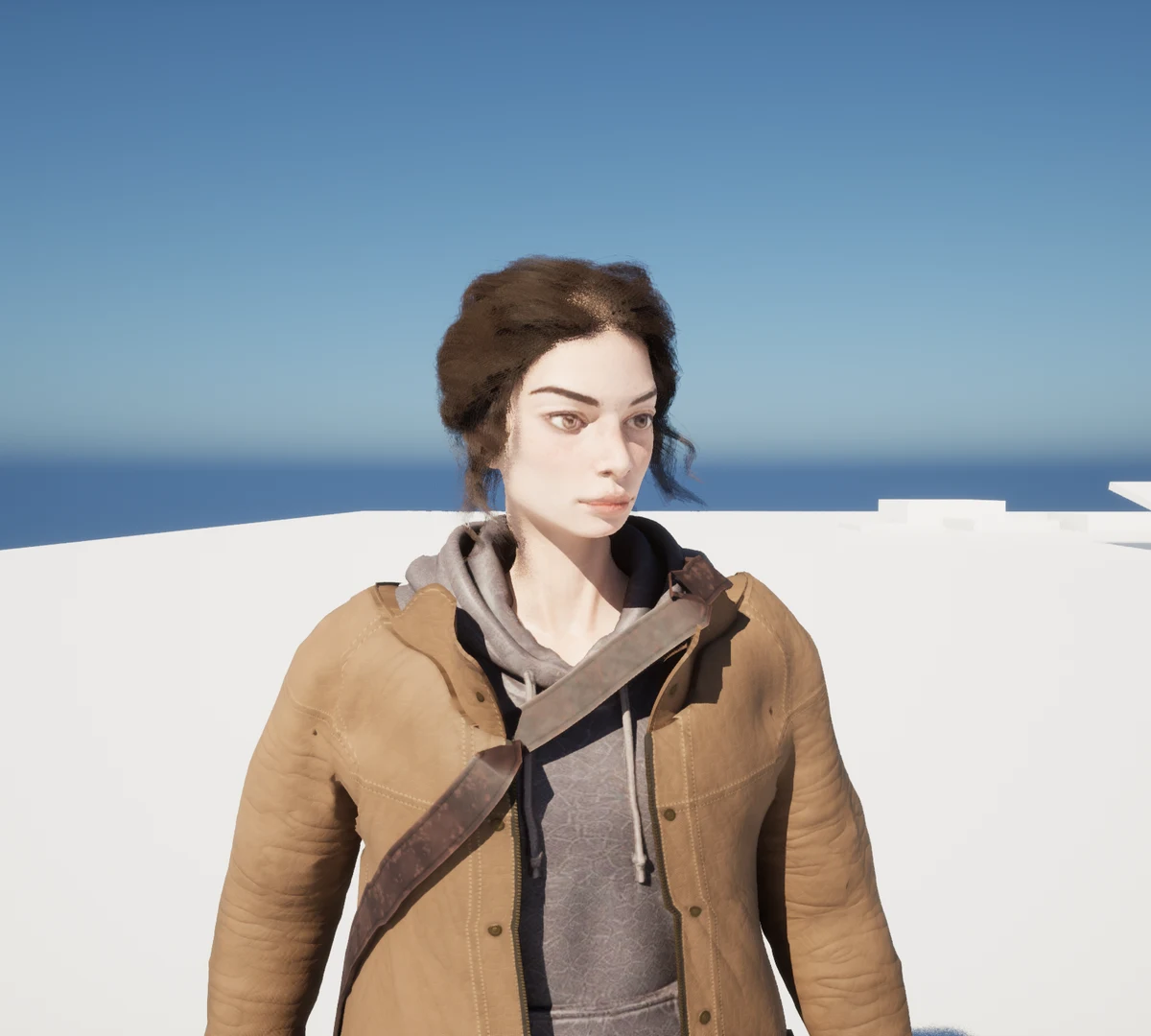 Before
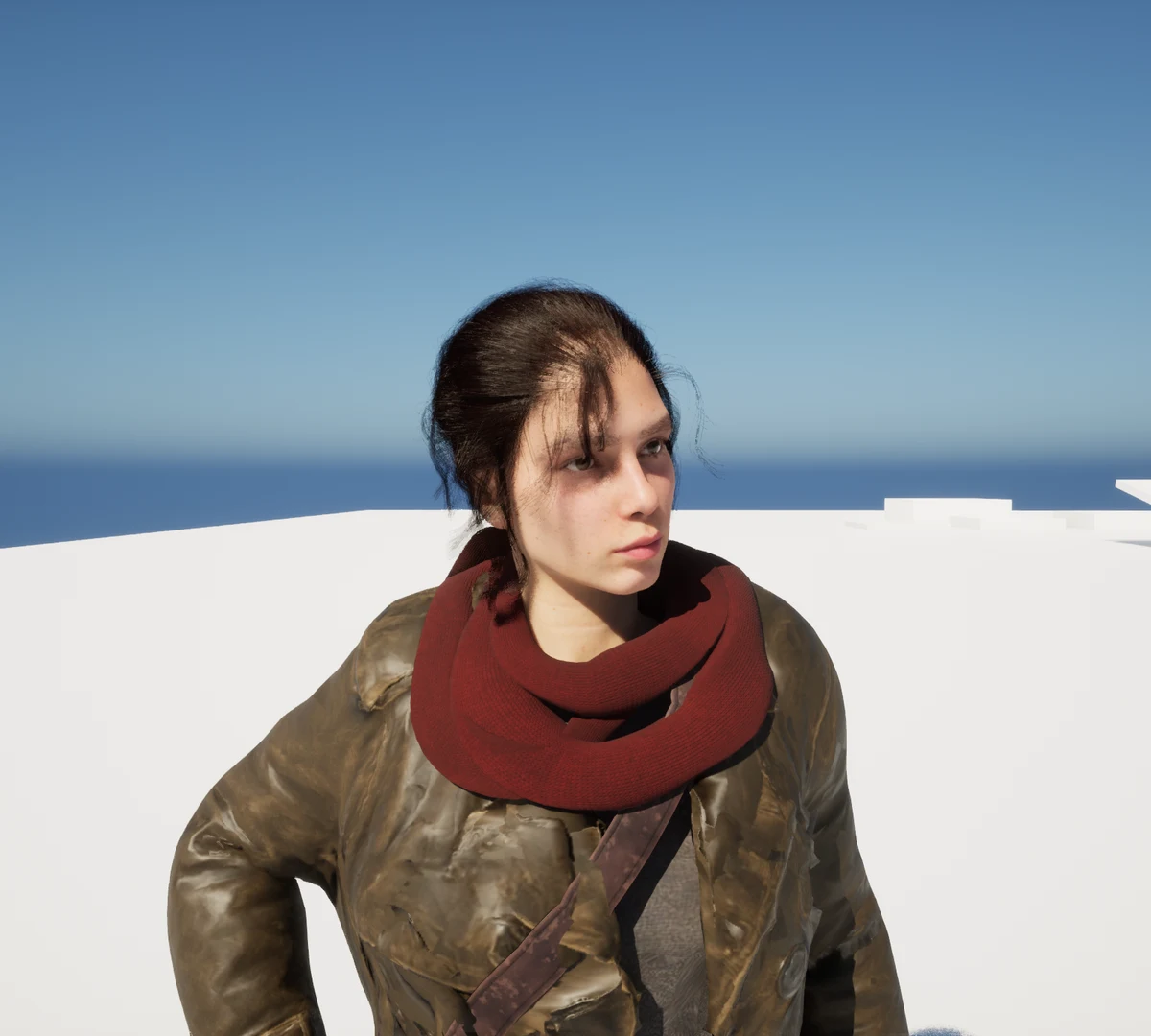 MetaHuman
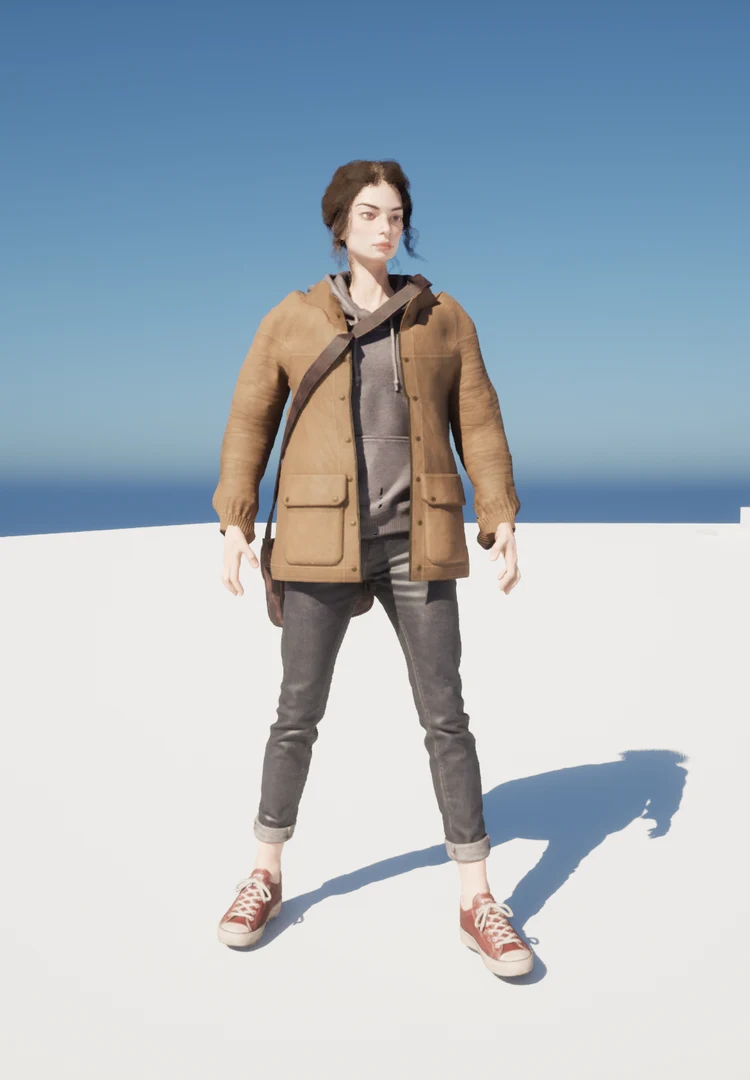 Before
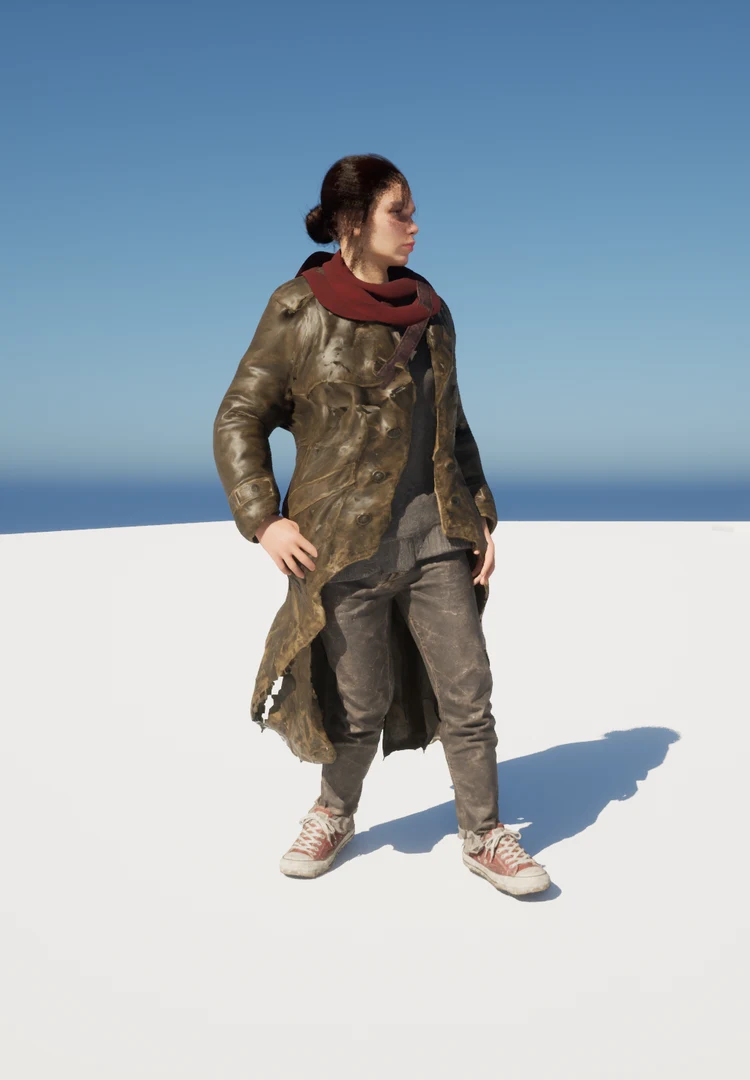 MetaHuman
The first version and the MetaHuman, same light, same cameras. Real captures in Unreal.
That could have meant redoing every animation. It didn't: since day 0 her body used the same skeleton as Epic's mannequin and MetaHuman, with the same bone names and the same hierarchy. Every animation in this post landed on the new body as it was.
Her coat is skinned above the waist and simulated below it, so the skirt swings when she walks and settles when she stops. The first simulation looked fine standing still and fell apart in motion: on a running turn, blade-like spikes shot out of the skirt, up to 59 cm long, and the hem bunched and snapped.
The cause was the simulation mesh. Thousands of the coat's visible vertices hung several centimetres off the surface that drives them, so every tilt swung them like levers. We rebuilt that mesh from scratch as one even grid hugging the skirt, cut the collision down to five capsules on the hips and legs, and smoothed how much freedom each part gets. 552 simulated particles became 297, the cost dropped from about 0.6 to 0.35 ms, and the spikes are gone in every motion she has. The scarf's tail is its own cloth, a little longer now, and moves on its own.
Most of this was planned with AI agents and built by them inside Unreal, through Sandscape's connection to the editor. They run Python in the editor, edit Blueprints and animation graphs, play the level and capture it.
The Rokoko takes imported, cut by frame range and cleaned by scripts inside the editor, rerun from the raw take after every change.
Her animation Blueprint edited by script: the haul loop, the reach pose and its hand IK, compiled and checked in place.
The level played by an agent, her head and pelvis measured over her feet while she hauls, until they matched the take.
Every in-game clip and screenshot on this page captured from her own camera, frame by frame.
But Sandscape is built on one idea: the people making the game keep creative control. So the testing that matters was ours. We played every build by hand, and when something felt off we said so: she should walk, not jog. The haul should use the pull from the capture. She bends too far forward on the rope. Reach for the tear point and keep reaching while she moves, without any pose a body can't make. The agents went and found why, fixed it and showed us the before and after. We bent the experience until it felt the way we wanted.
More and more, it feels like we get to spend our time on the creative side and less on the technical one, a bit like the creative directors of a big studio. Her first rig and her new garments came out of Sandscape too.
Devlog 3 covers how the three of us coordinated a lot of agents, devlog 4 how the four mechanics got working, and devlog 5 where the game came from.
An ordinary city starts coming apart.
Read itHer new look, the mocap and the MetaHuman rebuild.
You're hereHow three of us and many agents stayed pointed the same way.
Read it 4Sight, Rip, Rope and Bend, from grey gyms to the street.
Read it 5The jam's theme, shelved ideas and a song.
Read it