
It's the last day of the Epic AI MegaJam, and we submit tonight. We've written about coordination and getting the mechanics working. This time we're going back to the theme and the shelved ideas that became False Depth.
The themeTaking the theme literally
Epic described "Director's Cut" as a chance to build the feature or idea you'd shelved and never found a place for. We took it literally and looked at what we'd left aside in our own work.
Shelved for yearsWhat we'd shelved
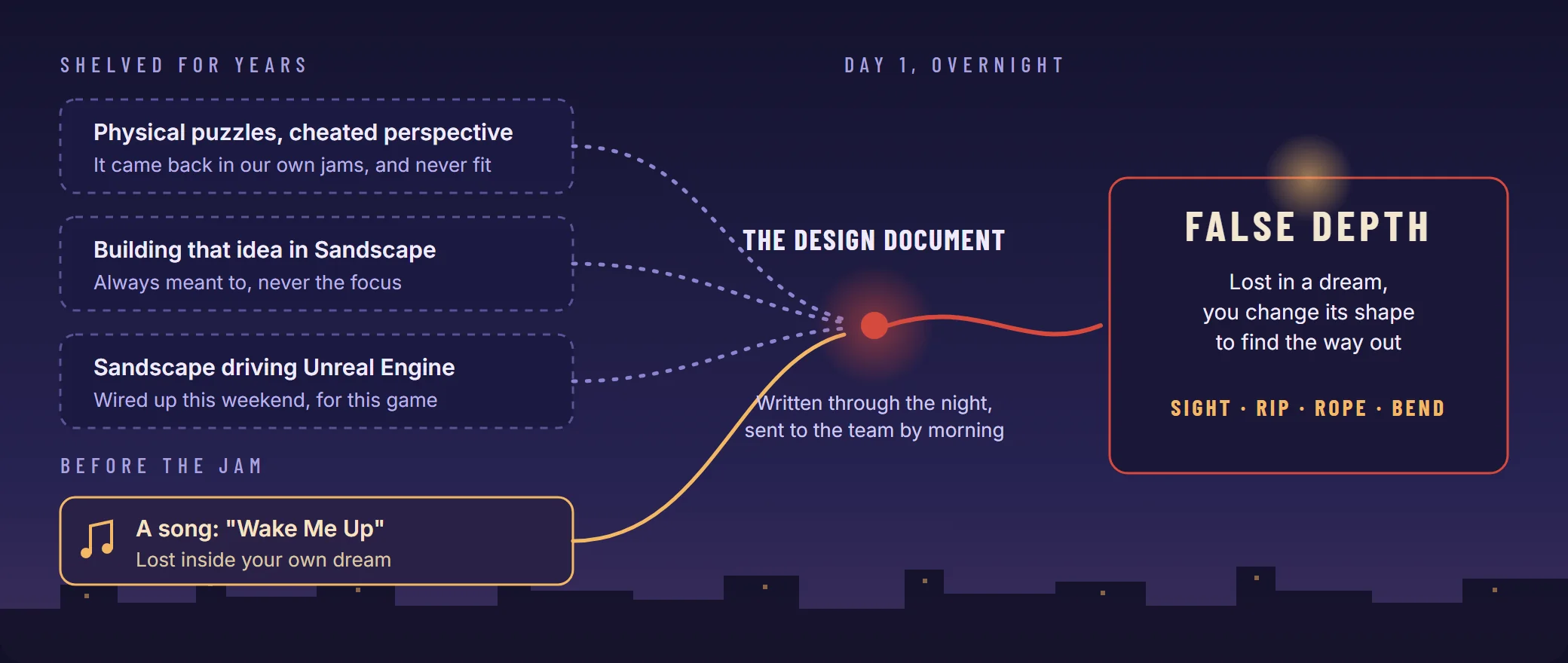
For years, our own small game jams kept bringing us back to puzzles built on physicality and cheated perspective: a world that only holds together when you see it from the right place. It never fit the games we were making. We'd meant to try it inside Sandscape, the platform we build, though it was never the focus. We'd also wanted to see how well Sandscape could work with Unreal Engine. For the jam, we built that integration and used it to make the whole game.
Day 1, overnightThe song and the first night
A week or two before the jam, Seb made "Wake Me Up" on Suno for fun. It's about being stuck inside your own dream, and he kept coming back to that feeling. After the theme announcement, we brainstormed a few directions without settling on one. In the middle of the first night, he was listening again and realized the dream and the perspective puzzles were the same game. He wrote the design document through the night and sent it to Laurent and Nathanael in the morning. We called the game Wake Up after the song during the first days; it's False Depth now. The track is public on Suno.
The gameChanging the dream's shape
In False Depth, you're lost in a dream and looking for its exit. You get out by directing the dream, changing its shape with Sight, Rip, Rope and Bend. Devlog 4 covers how they work. Cheated perspective belongs here because what you see in a dream is what's there.
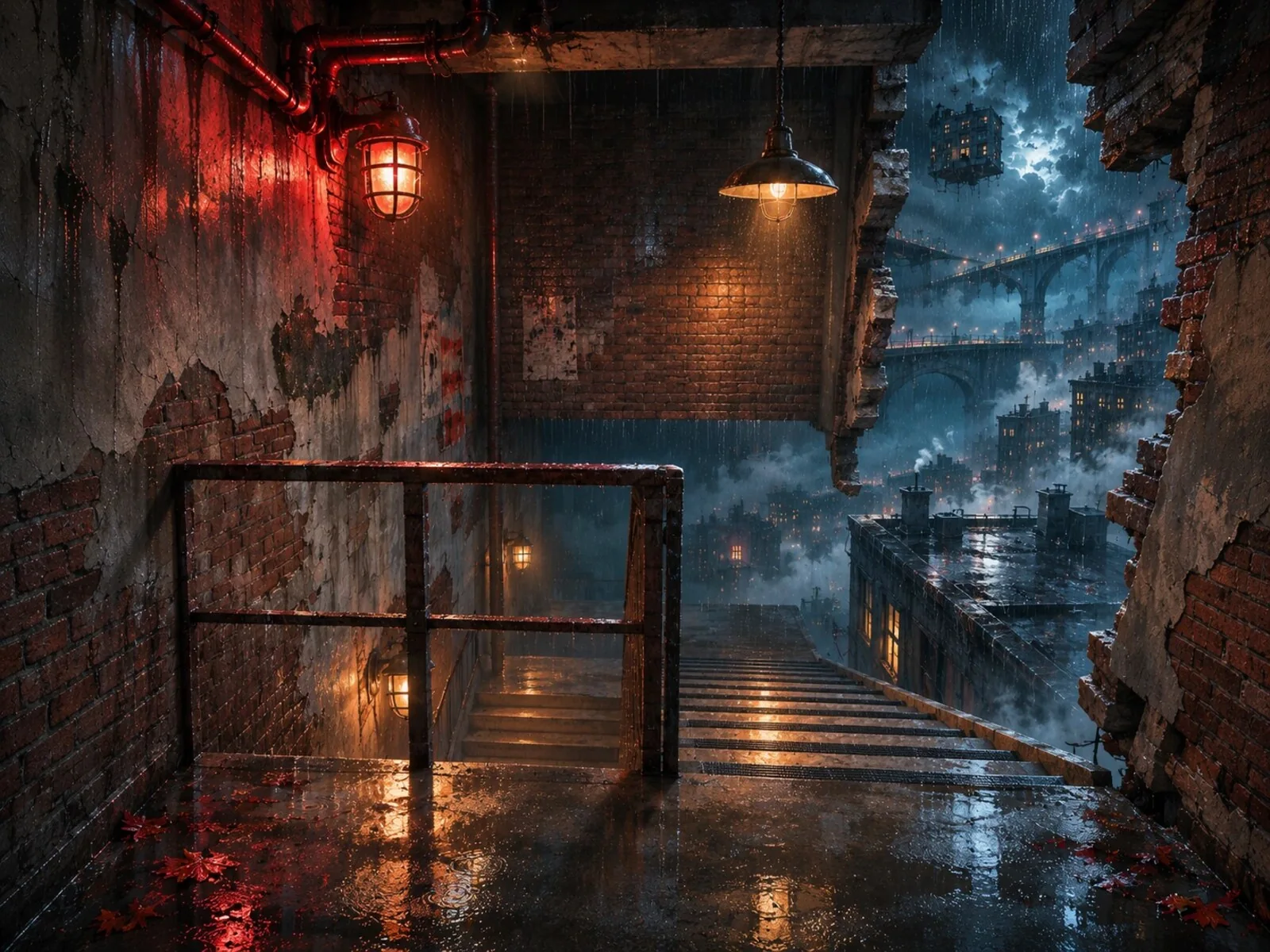

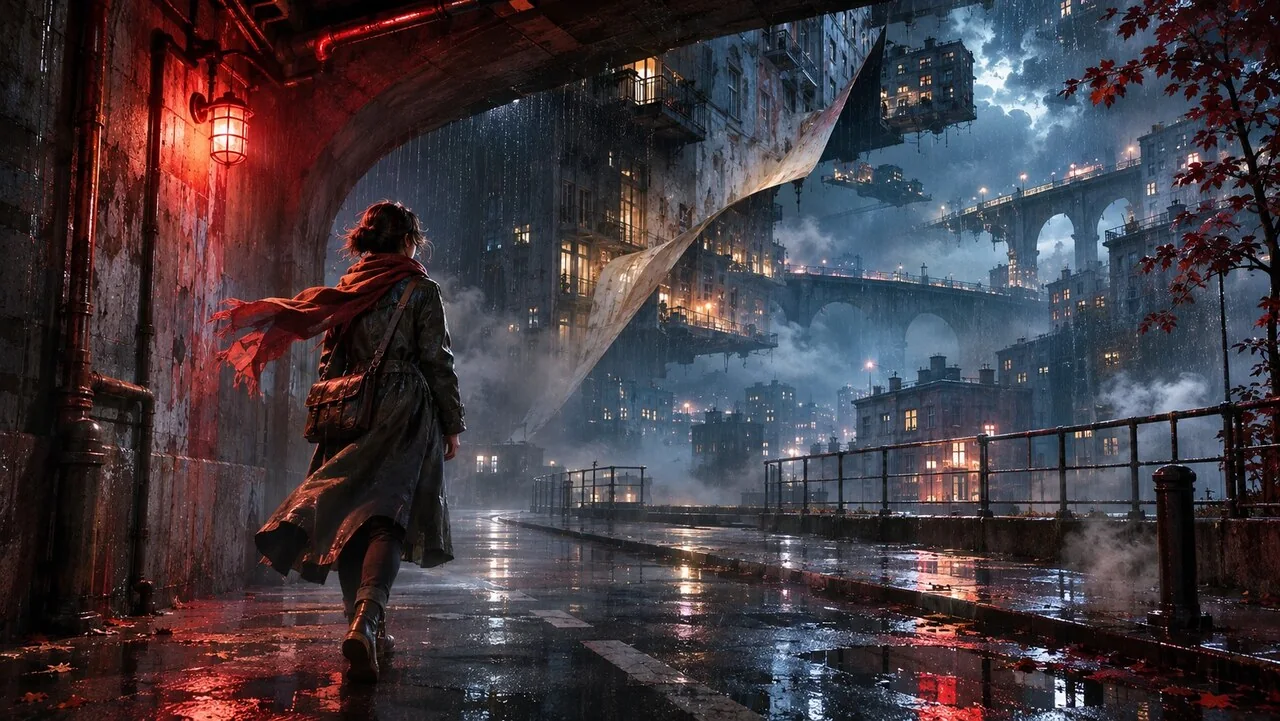
Three concept frames Nat made on November 15 for the dream's look. Generated concept art.
01Concept
The underpass in a storm. Generated concept art.
02In the game
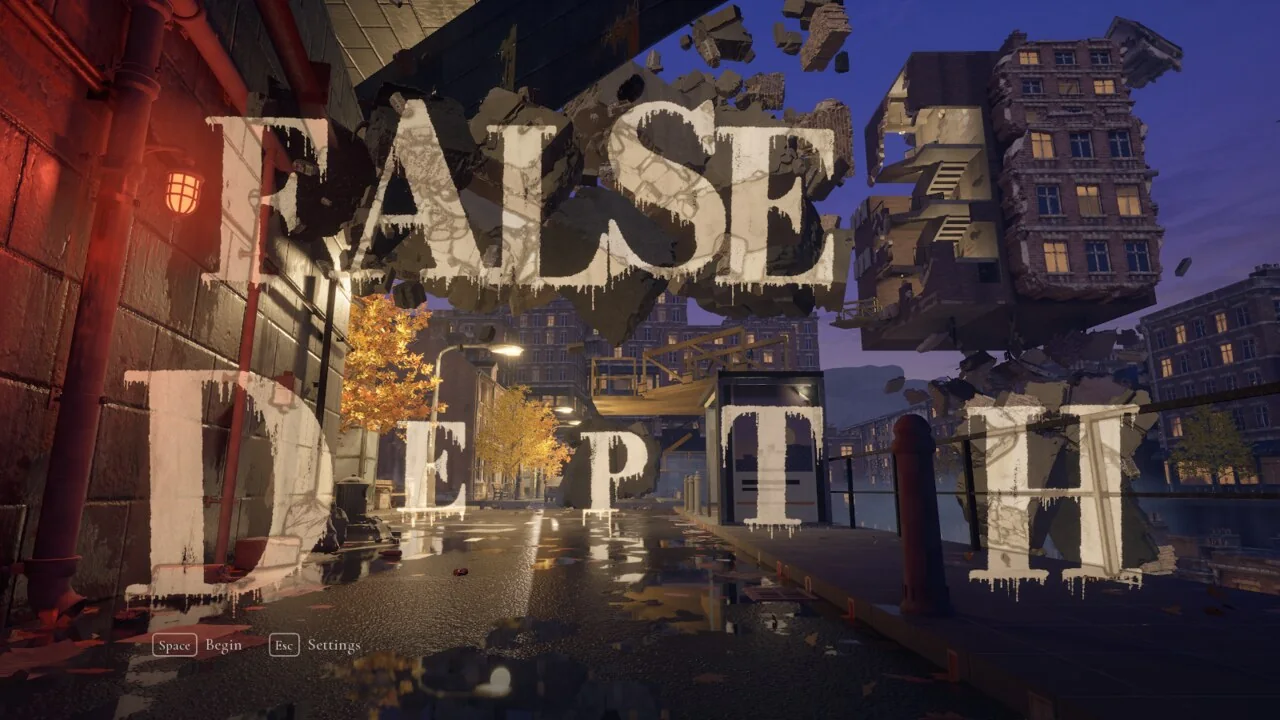
The same place in Unreal on November 15. Real capture.
An experimentTalking to her subconscious
On the first day we started an experiment: you speak into your microphone and her subconscious answers aloud. Our game otherwise has almost no words. Liquid's LFM3 Audio, a small speech model, runs entirely on your graphics card. Nothing goes to a server. We want a voice that understands who she is, the dream and where she's standing right now, and talks like a person, reacting, joking and getting things wrong. Early versions gave terse, analytical reports of her actions; we've pushed for natural conversation.
Its words never change the game or give solutions.
We keep it separate from the puzzles. Today it answers quickly on higher-end graphics cards, though it loses the thread after a while, which half-fits a dream. It may miss tonight's build. If so, it's the first thing we want to return to after the jam.
The teamWorking with AI agents
We directed a lot of AI agents while making this game, as devlog 3 describes. The idea they worked from came out of a song and a night of writing.
The seriesOur jam devlogs
15
The game
An ordinary city starts coming apart.
Read it 2Teaching her to move
Her new look, the mocap and the MetaHuman rebuild.
Read it 3People and AI agents
How three of us and many agents stayed pointed the same way.
Read it 4The mechanics
Sight, Rip, Rope and Bend, from grey gyms to the street.
Read itWhere it came from
The jam's theme, shelved ideas and a song.
You're here